 Whalesbook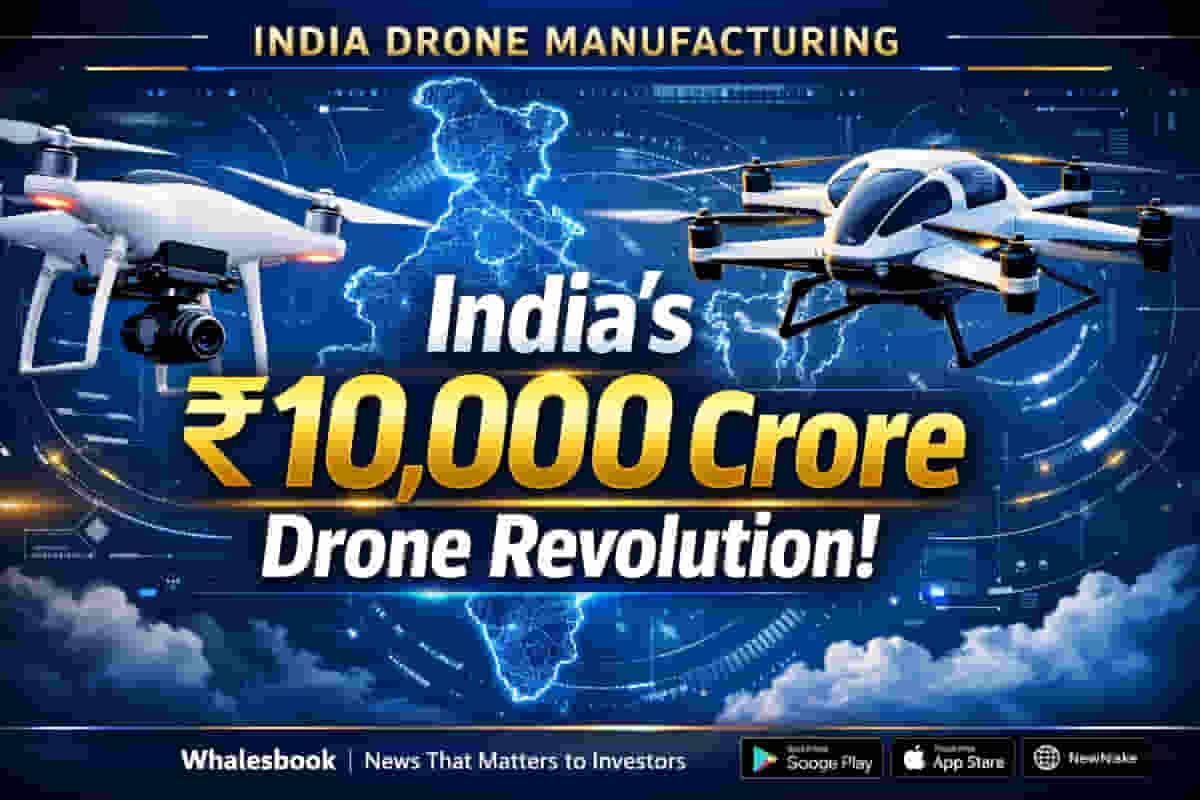
India Launches Massive ₹10,000 Crore Drone Manufacturing Boost
The Indian government is poised to launch a substantial five-year incentive scheme, potentially worth around ₹10,000 crore, aimed at dramatically accelerating indigenous drone manufacturing. Sources indicate this significant fiscal commitment will be announced in the upcoming Budget 2026, underscoring India's ambition to become a global powerhouse for civilian unmanned aerial vehicles (UAVs). This new initiative, under the 'Drone Shakti' umbrella, moves beyond output-based rewards to offer long-term fiscal certainty for manufacturers.
The Core Issue
India's burgeoning drone sector currently faces challenges related to imported components and a lack of large-scale manufacturing capacity. While the import of finished drones is restricted, critical parts like sensors, avionics, and propulsion systems are still sourced internationally, limiting value addition within the country. This proposed scheme seeks to directly address this by fostering end-to-end manufacturing capabilities domestically.
Financial Implications
The comprehensive plan, expected to align with the Sixteenth Finance Commission period, involves a fiscal outlay of approximately ₹10,000 crore. The finance ministry has already given in-principle approval, with expectations of full upfront expenditure clearance. This multi-year commitment is designed to provide the necessary investment climate for companies to scale up operations.
Two-Tier Subsidy Framework
A key feature of the proposed scheme is its innovative two-tier subsidy structure. The first layer will offer a 10–15 percent subsidy on capital expenditure, supporting the establishment of manufacturing facilities and related infrastructure. This is contingent upon meeting minimum turnover thresholds and completing investments within specified timelines, ensuring prompt capacity creation.
The second layer will provide a similar 10–15 percent subsidy tied to manufacturing output. This component is crucial for making domestically produced drones cost-competitive against imports, directly addressing the pricing gap faced by Indian firms due to reliance on foreign components.
Supporting Scale and Local Sourcing
The scheme's objective is not just about assembly but genuine manufacturing. A mandatory domestic content requirement of 50–60 percent is being stipulated. This ensures that companies actively integrate local sourcing for key components, thereby boosting India's component manufacturing ecosystem and reducing dependence on external supplies.
Graded Incentives and Early Entry
To encourage participation without penalizing latecomers, the scheme will incorporate a graded incentive structure. Early entrants are expected to receive full benefits, while those joining later will see tapered incentives. However, the overall five-year coverage aims to prevent any significant disadvantage for new participants.
Complementary to Existing Schemes
Officials emphasize that this new initiative is distinct from and complementary to the existing Production-Linked Incentive (PLI) scheme for drones. The PLI scheme, with its smaller outlay, focuses primarily on value addition and output. The new proposal's emphasis on upfront investment and scale creation addresses a different, yet equally critical, aspect of sector development.
Future Outlook
By providing robust fiscal backing and mandating domestic content, India aims to transform itself into a global manufacturing hub for civilian drones. This could lead to significant growth in the sector, fostering innovation, job creation, and technological self-reliance. The long-term nature of the fiscal support is intended to instill confidence for substantial private sector investment.
Impact
This multi-billion dollar initiative is expected to significantly boost companies involved in drone manufacturing, component production, and related R&D. Investors may see increased opportunities in the Indian aerospace and defense sectors. It could also lead to greater availability and affordability of drones for various applications, from agriculture to logistics, potentially impacting multiple industries.
Impact Rating: 8/10
Difficult Terms Explained
- Drone Shakti: A government initiative aimed at promoting the drone ecosystem in India, focusing on adoption, services, and now manufacturing.
- PLI (Production-Linked Incentive): A government scheme offering financial incentives to companies based on their incremental sales of manufactured goods.
- Capital Expenditure (CapEx): Funds used by a company to acquire, upgrade, and maintain physical assets like property, buildings, and equipment.
- Subsidy: Financial assistance provided by the government to reduce the cost of goods or services for consumers or businesses.
- Indigenous: Produced or manufactured in one's own country; native.
- Avionics: The electronic systems used on aircraft, spacecraft, and satellites, including navigation, communication, and flight control systems.
- Propulsion Systems: The systems that provide thrust to move a vehicle, such as engines or motors.
- Value Addition: The increase in worth or utility of a product or service as a result of a particular activity.
- Fiscal Commitment: A pledge by a government or organization to provide a specific amount of funding over a period.