 Whalesbook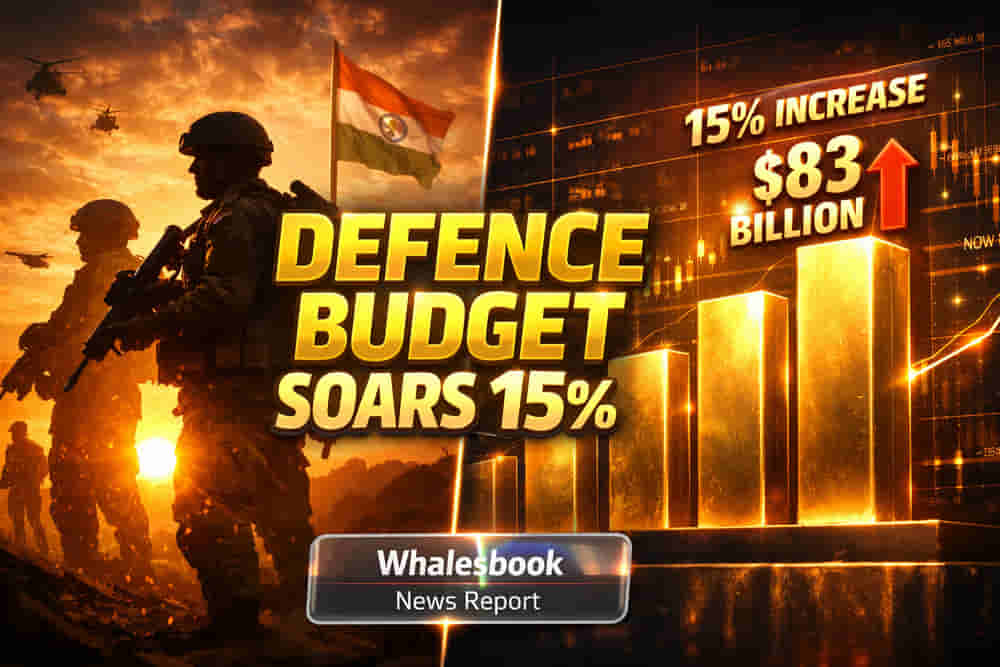
The increased budget signals a pronounced strategic shift, prioritizing both external deterrence and internal industrial capacity. This enhanced fiscal commitment directly addresses persistent geopolitical pressures, particularly along the northern and western borders, while simultaneously injecting substantial capital into the nation's defence industrial ecosystem. The allocation underscores a sustained government drive to equip forces with cutting-edge technology and reduce reliance on foreign military hardware.
Strategic Spending Surge
India's defence budget for the current financial year, FY2026-27, has been set at ₹7.85 lakh crore, marking a nearly 15% increase from the prior year's ₹6.81 lakh crore. This significant fiscal expansion is a direct response to the nation's complex security environment, characterized by ongoing border disputes and regional instability. The substantial hike in capital expenditure, which has jumped 28% to ₹2.31 lakh crore from ₹1.80 lakh crore, is earmarked for acquiring advanced weapon systems and accelerating military modernization efforts. This aggressive push for hardware upgrades reflects a clear strategy to maintain strategic deterrence and enhance national security posture.
Domestic Manufacturing Receives a Tailwind
Beyond direct acquisition, the elevated capital outlay is strategically designed to stimulate India's domestic defence manufacturing sector. The focus on modern systems acquisition is intended to foster indigenous technological capabilities, a cornerstone of the 'Make in India' and 'Atmanirbhar Bharat' (self-reliant India) initiatives within defence. This policy direction is expected to create significant opportunities for Indian defence companies, potentially leading to enhanced order books and revenue growth for key players in the sector.
Sector Performance and Outlook
Major Indian defence companies have already shown strong performance, anticipating such fiscal support. Hindustan Aeronautics Limited (HAL) commands a market capitalization of approximately ₹1,50,000 crore with a P/E ratio around 35x, while Bharat Electronics Limited (BEL) is valued at about ₹80,000 crore with a P/E of 28x. Bharat Dynamics Limited (BDL) has a market capitalization near ₹30,000 crore and a P/E of 40x, and Mishra Dhatu Nigam (MIDHANI) holds a market cap of around ₹8,000 crore with a P/E of 30x. Recent reports highlight robust order books for HAL, successful missile test firings for BDL, and new radar system developments for BEL, alongside material supply contracts for MIDHANI. Analysts suggest that while defence stocks often experience a positive short-term reaction to budget announcements, their long-term trajectory depends on efficient contract execution and sustained policy continuity. The Indian defence sector is projected to witness robust growth in the coming years, with forecasts indicating a significant compound annual growth rate of 9-11%, propelled by ongoing modernization programs and the push for domestic production. However, it is noteworthy that defence expenditure as a percentage of GDP has seen a gradual decline over the past decade, despite absolute increases, currently hovering around 2.5%.