 Whalesbook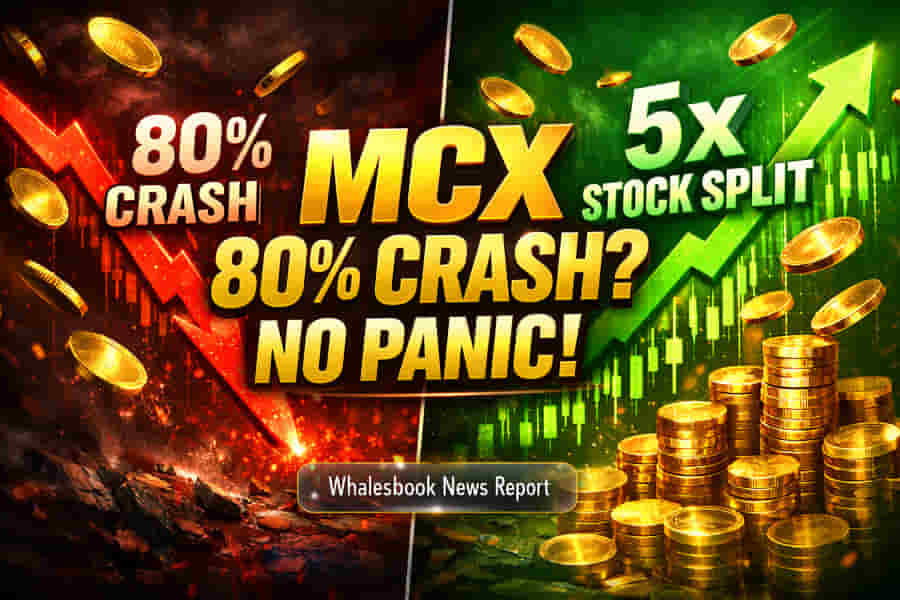
MCX Shares Plunge Over 80%: A Technical Correction, Not a Crisis
Multi Commodity Exchange of India (MCX) shares were in the spotlight today following a startling headline drop of over 80%. This dramatic fall, occurring on the BSE, initially sparked fears of a significant market downturn for the commodity exchange. However, a closer examination reveals that this steep decline was purely a technical adjustment stemming from the company's recent 1:5 stock split.
The shares, which concluded trading at ₹10,989 on January 1, 2026, opened at approximately ₹2,228 today. This price disparity accounts for the perceived plunge. Crucially, when adjusted for the stock split, MCX shares actually posted a gain of 3.6%, reaching a new 52-week high of ₹2,277. Concurrently, the company's market capitalization climbed to ₹56,650 crore, indicating that investor wealth has remained unaffected by this technical manoeuvre.
The Mechanics of a Stock Split
MCX announced its 1:5 stock split in September last year. This corporate action involved dividing each existing equity share, with a face value of ₹10, into five new shares, each with a face value of ₹2. The primary objectives behind this decision were to enhance market liquidity and make the stock more affordable and accessible to a wider array of investors. The record date for determining shareholders eligible for this split was fixed for January 2, 2026. It is important for investors to understand that while the number of outstanding shares increases significantly, the total market capitalization, and consequently the total value of an investor's holdings, remains constant immediately after the split.
Regulatory Tailwind for Commodity Markets
Beyond the internal corporate action, the broader Indian commodity derivatives market is poised for growth, largely due to proactive regulatory initiatives. Tuhin Kanta Pandey, Chairman of the Securities and Exchange Board of India (SEBI), recently signalled a series of reforms designed to significantly boost institutional participation. SEBI is actively collaborating with other key financial regulators, including the Reserve Bank of India (RBI) and the Insurance Regulatory and Development Authority of India (IRDAI).
The goal of this inter-regulatory cooperation is to facilitate the broader participation of banks and insurance companies in the commodity derivatives space. Pandey emphasized that enhanced institutional involvement is expected to inject higher liquidity into the markets, making them a more attractive platform for hedging risks. Furthermore, SEBI is committed to resolving Goods and Services Tax (GST) related challenges faced by market participants, particularly those involved in physical delivery of commodities. Efforts are also underway to extend reporting facilities, such as the Samuhik Prativedan Manch, to commodity-only brokers.
MCX's Market Performance and Future Prospects
Multi Commodity Exchange of India has demonstrated robust performance in the past year, with its stock surging approximately 80%. This represents a significant outperformance when compared to the BSE Sensex's gain of 7% over the same period. The stock has also experienced a remarkable climb of 158% from its 52-week low of ₹882, which was recorded on March 11, 2025. The commodity derivatives market, in general, has seen a substantial increase in activity. The annual notional turnover for FY 2024-25 reached ₹580 lakh crore, nearly doubling from the preceding fiscal year. By October 31, 2025, the notional turnover had already surged to ₹628 lakh crore, underscoring the growing depth and activity in this sector. SEBI has overseen commodity derivatives markets since 2015, fostering their development.
Impact
The immediate impact of this news is the clarification of a technical stock adjustment for MCX investors, preventing undue panic. On a broader scale, the SEBI-driven reforms signal a positive outlook for the Indian commodity derivatives market. Increased institutional participation and liquidity could lead to more efficient price discovery, better hedging opportunities, and potentially attract significant new capital inflows into the sector. This could benefit not only exchanges like MCX but also commodity producers, consumers, and financial institutions involved in hedging and investment.
Impact Rating: 7/10
Difficult Terms Explained
- Stock Split: A corporate action where a company divides its existing shares into multiple new shares. This increases the number of shares outstanding while proportionally reducing the price per share, aiming to improve liquidity and affordability.
- Market Capitalisation: The total market value of a company's outstanding shares, calculated by multiplying the total number of shares by the current market price of one share. It represents the company's overall worth in the stock market.
- Liquidity: The degree to which an asset or security can be quickly bought or sold in the market at a price reflecting its intrinsic value. High liquidity means it's easy to trade without significant price changes.
- SEBI: Securities and Exchange Board of India, the primary regulator of the securities and commodities markets in India.
- RBI: Reserve Bank of India, the central banking institution responsible for monetary policy and regulation of the banking sector in India.
- IRDAI: Insurance Regulatory and Development Authority of India, the statutory body that regulates the insurance industry in India.
- Commodity Derivatives Market: A marketplace where financial contracts whose values are derived from the price of an underlying commodity (such as oil, gold, agricultural products) are traded.
- Hedging: A risk management strategy used to offset losses or gains that may be incurred by a simultaneous opposite transaction. It's a way to protect against adverse price movements.
- GST: Goods and Services Tax, a comprehensive indirect tax applicable to the supply of goods and services across India.
- Notional Turnover: The total value of all derivative contracts traded in a market over a specific period. It is calculated by multiplying the contract price by the quantity and number of contracts traded, serving as an indicator of market activity.
- 52-week high/low: The highest and lowest prices at which a stock has traded during the preceding 52 weeks (one year).