

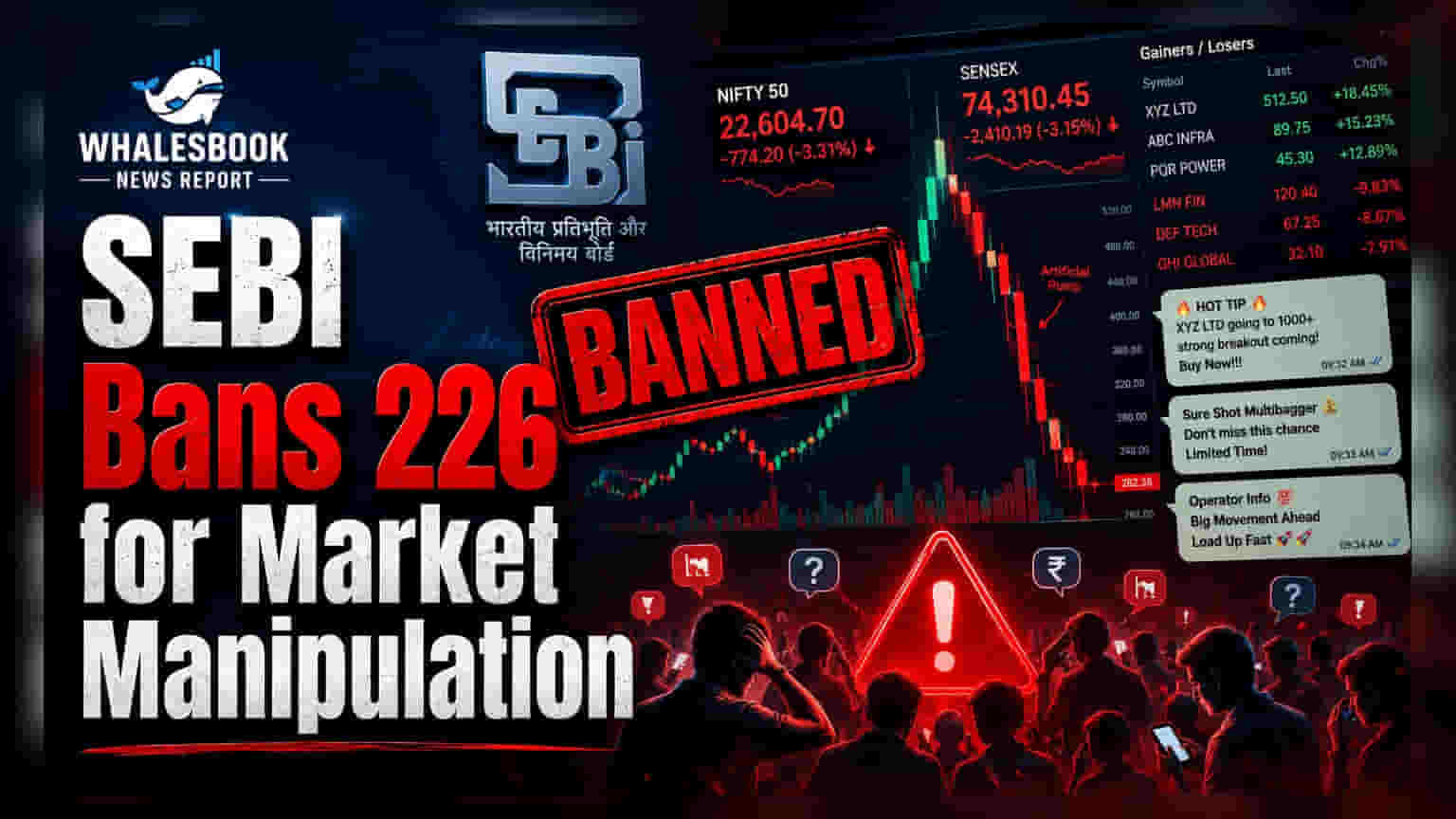
SEBI has banned 226 entities for up to 7 years for a market manipulation scheme. The scheme artificially inflated prices of five stocks, including Mauria Udyog Ltd., from 2017-2020. Investors were targeted via fake recommendations.
SEBI Bans 226 Entities in Market Manipulation Scheme
SEBI has imposed a significant ban on 226 entities for their involvement in a sophisticated market manipulation scheme spanning from 2017 to 2020. The order, dated July 7, 2026, targets the artificial inflation of prices and volumes in five listed companies: Mauria Udyog Ltd. (MUL), Vishal Fabrics Ltd. (VFL), 7NR Retail Ltd. (7NR), Darjeeling Ropeway Company Ltd. (DRCL), and GBL Industries Ltd. (GBL).
What just happened
SEBI's investigation identified a complex structure involving 'PV Influencers', 'Collaborators', and 'Offloaders' who engineered price and volume manipulation. For Mauria Udyog Ltd. (MUL) alone, unlawful gains identified amounted to ₹143.79 crore. During the period of manipulation (SMS period), MUL saw its stock price surge by 61.32% and trading volume by 1638% compared to pre-SMS levels, despite reporting a net loss of ₹12.65 crore and a 35% revenue drop in the September 2019 quarter.
Why this matters
This regulatory action serves as a strong deterrent against market abuse. It highlights the severe consequences for entities involved in manipulating stock prices, particularly in illiquid scrips. The ban, coupled with monetary penalties and disgorgement of unlawful gains with interest, significantly impacts the implicated parties.
The backstory
The scheme operated in three phases: artificial creation of price and volume through structured trades, inducement of retail investors via bulk SMS campaigns mimicking reputed brokers and fake buy recommendations, and finally, offloading shares to unsuspecting retail investors at inflated prices. Funds were then routed through conduit entities and Forex companies to obscure the trail.
What changes now
All 226 implicated entities are debarred from the securities market for periods ranging from 4 to 7 years. Monetary penalties, including a ₹10 crore fine on the alleged mastermind Hanif Shekh, have been levied. Furthermore, these entities must disgorge their unlawful gains with 12% annual interest.
Risks to watch
This case underscores the significant risks associated with investing in illiquid small-cap stocks exhibiting unusual price and volume movements without underlying fundamental support. Investors must be extremely cautious of unsolicited investment advice, especially through digital channels.
Peer comparison
The manipulation involved multiple scrips, indicating a pattern of exploiting illiquid stocks. While specific peer actions aren't detailed, the scale of 226 entities and five scrips suggests a widespread operation.
Context metrics (time-bound)
- Unlawful gains (MUL): ₹143.79 crore (2017-2020)
- MUL net loss: ₹12.65 crore (September 2019 quarter)
- MUL revenue drop: 35% (September 2019 quarter)
- Collaborators' losses (MUL): ₹0.52 crore (SMS period)
- MUL volume increase: 1638% (SMS vs Pre-SMS)
- MUL price increase: 61.32% (SMS vs Pre-SMS)
What to track next
Investors should monitor the enforcement of SEBI's order, including the recovery of disgorged gains. The market will also be watching for any new patterns of manipulation and the effectiveness of SEBI's surveillance mechanisms.
Reader Takeaway: SEBI's ban on 226 entities deters market abuse; retail investors face risks in illiquid stocks.