 Whalesbook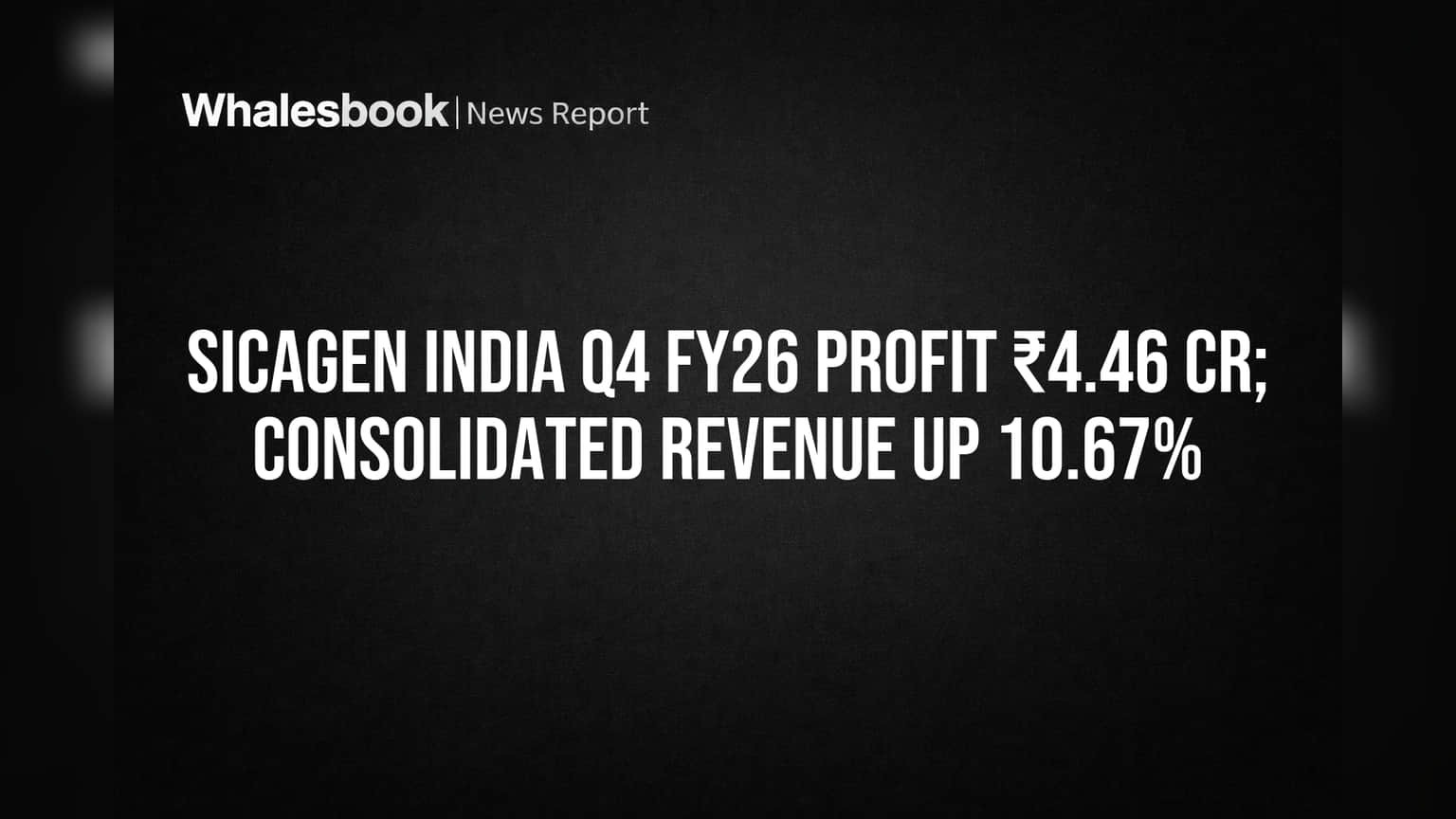


Sicagen India Sees Strong Consolidated Revenue Growth Amid Standalone Challenges
Financial Results Revealed
Sicagen India Ltd announced its financial results for the fourth quarter and full year ended March 31, 2026. The company reported a consolidated net profit of ₹4.46 crore for Q4 FY26. Consolidated revenue for the quarter reached ₹281.02 crore, marking a 10.67% increase year-on-year.
For the full fiscal year FY26, consolidated revenue grew by 9.26% to ₹983.26 crore. However, standalone figures showed a mixed performance. Standalone revenue for Q4 FY26 rose modestly by 2.53% to ₹141.29 crore, but the full-year standalone revenue saw a decrease of 3.26%, falling to ₹528.22 crore from ₹546.03 crore in FY25. Additionally, standalone total equity declined from ₹43,948 lakhs in FY25 to ₹42,091 lakhs in FY26. The company's auditors provided an unmodified opinion on the financial results.
Key Performance Drivers and Challenges
The results highlight a significant difference between Sicagen India's consolidated and standalone operations. The consolidated business appears to be performing well, potentially benefiting from broader market trends or diversified project wins in the power Engineering, Procurement, and Construction (EPC) sector.
In contrast, the standalone business faced challenges, leading to a revenue decline. This performance split, along with an exceptional item recorded for the statutory impact of new Labour Codes, suggests that the company might face margin pressures and operational adjustments. The implementation of new Labour Codes from FY2026 affects employee costs such as gratuity and compensated absences.
Industry Context and Peer Comparison
Sicagen India operates in the power EPC sector, an industry closely tied to government infrastructure spending, evolving regulatory policies, and the shift towards renewable energy. Companies in this field typically manage complex project execution, working capital, and compliance.
Peers like Kalpataru Projects International Ltd and KEC International Ltd, also active in the power transmission and distribution EPC space, often see growth driven by large infrastructure projects. Sicagen's consolidated growth aligns with positive industry trends, but its standalone segment's performance lags behind.
Future Outlook and Investor Focus
Looking ahead, investors will monitor several key areas. Consolidated revenue streams remain robust, indicating positive market traction for the group. However, the persistent decline in standalone annual revenue requires closer attention.
The recommended dividend of 10% (₹1 per share) offers a return to shareholders, supported by a clean audit report. A critical watch point will be the impact of new Labour Codes on operating margins and overall profitability, as increased operating costs are anticipated. The reduction in standalone equity also warrants attention regarding the company's capital management strategy. Investors will be tracking order inflows, the execution pipeline, and any steps Sicagen India takes to revive its standalone revenue streams.