 Whalesbook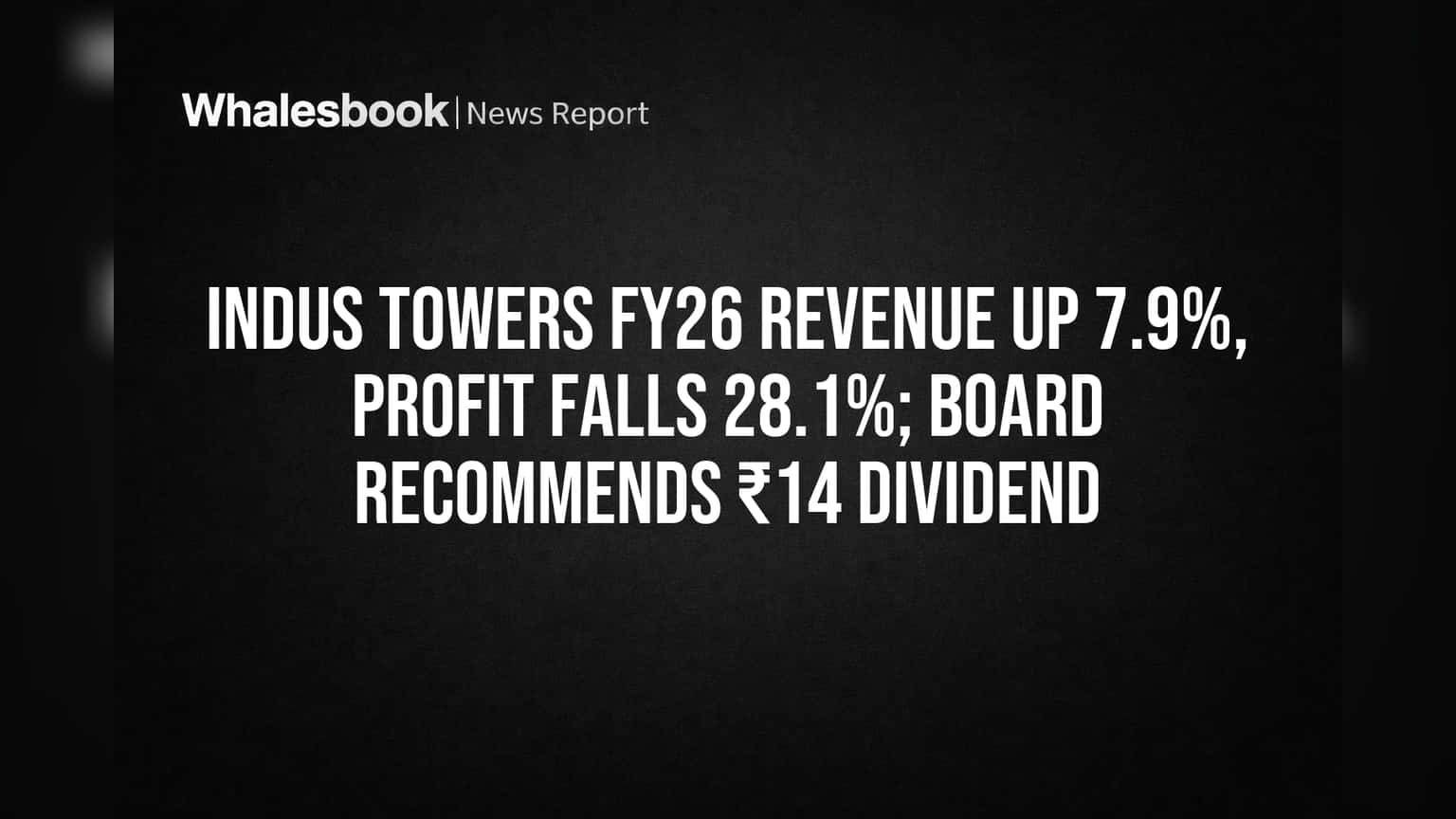


Indus Towers Reports Mixed FY26 Results: Revenue Up, Profit Down
Indus Towers reported its fourth-quarter and full-year financial results for FY26. For the three months ending March 31, 2026, revenue rose 4.8% year-on-year to ₹8,101 crore, with profit after tax increasing marginally by 0.8% to ₹1,793 crore. The company's Board has recommended a final dividend of ₹14 per share for the full fiscal year.
For the full fiscal year 2026, consolidated revenue grew 7.9% to ₹32,493 crore. However, consolidated profit after tax for the year fell significantly by 28.1% to ₹7,145 crore. These results highlight sustained demand for telecom infrastructure, evident in revenue growth driven by network expansion and co-location additions. The sharp profit decline, however, signals pressure from rising operational costs or margin challenges. While the dividend offers a direct return to shareholders, the drop in profitability requires a closer look at the company's cost management and operational efficiency.
Indus Towers, India's largest telecom tower provider, plays a crucial role in the nation's 5G rollout, supporting major clients like Bharti Airtel and Vodafone Idea. In the prior fiscal year, 2025, the company saw strong growth, with revenue up 5.3% and profit soaring 64.5%. The company is also exploring international expansion, particularly into Africa, and aims to enhance operations using digital tools and AI.
Financial Pressures and Risks
Several financial indicators point to these pressures. Consolidated EBITDA for FY26 decreased by 13.8% year-on-year, indicating a hit to operating profitability. Operating Free Cash Flow also declined by 15.3% in Q4 FY26.
Key profitability metrics showed year-on-year drops, including Return on Equity (pre-tax and post-tax) and Return on Capital Employed. Separately, Indus Towers is contesting a ₹4.52 crore GST penalty from February 2025, though it has stated this would not materially affect its financials.
Competitive Landscape and Future Outlook
Indus Towers operates in a competitive market. Key rivals include Brookfield and companies like Tower Vision and GTL Infrastructure. Despite competition, Indus Towers maintains a leading market position due to its extensive network scale.
Looking ahead, investors will monitor the progress of the Africa expansion initiative as a potential new revenue stream. Tracking the impact of digital and AI strategies on operational efficiency will also be key. Management commentary on cost control measures and strategies to boost profitability will be closely watched, alongside customer network expansion plans and their effect on future revenues. Updates on the GST penalty and any other potential litigation will also be important to follow.