 Whalesbook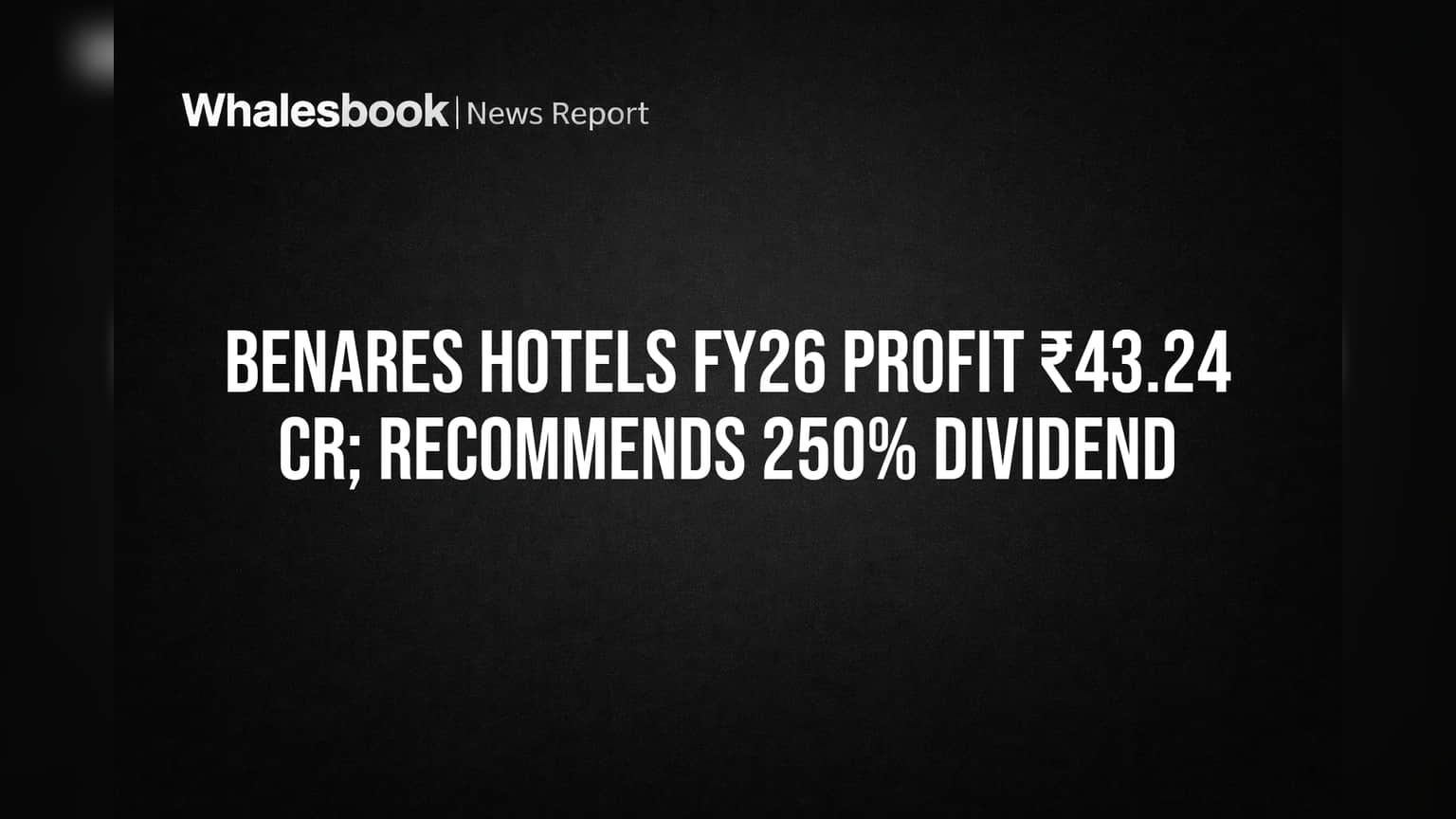


Key Financials and Board Appointments
On April 29, 2026, Benares Hotels Limited's Board of Directors approved the company's audited financial results for the fiscal year ending March 31, 2026. The company reported a Profit After Tax (PAT) of ₹4,323.89 lakh (approximately ₹43.24 crore). A final dividend of 250%, or ₹25 per share, was recommended, subject to shareholder approval. Total Comprehensive Income for the period stood at ₹4,316.39 lakh (₹43.16 crore).
The board also approved the appointment of Mr. Rajendra Misra and Mr. Anupam Chaturvedi as directors, and accepted the resignation of Mr. Beejal Desai. An incremental impact of ₹13.34 lakh due to new Labour Codes was noted under Exceptional Items.
What This Means for Investors
The reported profit for FY26 shows consistent performance for Benares Hotels. The proposed dividend offers a potential return to shareholders, pending their vote. The appointments to the board could lead to adjustments in corporate governance or strategic focus.
Company Background and Context
Benares Hotels Ltd., established in 1971 and based in New Delhi, manages hotels such as Taj Ganges and Taj Nadesar Palace in Varanasi. It has been a subsidiary of The Indian Hotels Company Limited (IHCL) since 2011. The company typically rewards shareholders with dividends, historically offering a yield around 0.25%.
Benares Hotels is also expanding its capacity with a new 100-room wing at Taj Ganges, slated to open this fiscal year. The broader Indian hospitality sector is adapting to new Labour Codes introduced around November 2025. These modernize employment rules, impacting payroll and benefits, notably requiring basic pay to be at least 50% of total remuneration.
For comparison, Benares Hotels reported a Profit After Tax of ₹43.2 crore for FY25 on revenue of ₹140.7 crore, showing similar profitability levels to FY26.
Potential Risks
The final dividend payment hinges on shareholder approval. The incremental costs of ₹13.34 lakh from the new Labour Codes, though small, highlight potential ongoing compliance adjustments and operational expense impacts.
Competitive Landscape
Benares Hotels competes with major hospitality groups including its parent company, The Indian Hotels Company Ltd. (IHCL), EIH Ltd. (Oberoi), and ITC Ltd.'s Hotels Division. IHCL is India's largest hotel chain.
While IHCL reported consolidated revenue of ₹2,900 crore for Q3 FY26, competitors like EIH Ltd. and ITC Hotels trade at P/E ratios of approximately 32x and 31.67x, respectively, suggesting typical market valuations for established players.
What to Watch
Shareholders will vote on the proposed final dividend of ₹25 per share, a key decision impacting shareholder returns. The new directors, Mr. Rajendra Misra and Mr. Anupam Chaturvedi, may influence the company's future governance and strategy. Investors will also monitor updates on the new 100-room wing at Taj Ganges and any further financial implications of the new Labour Codes.