 Whalesbook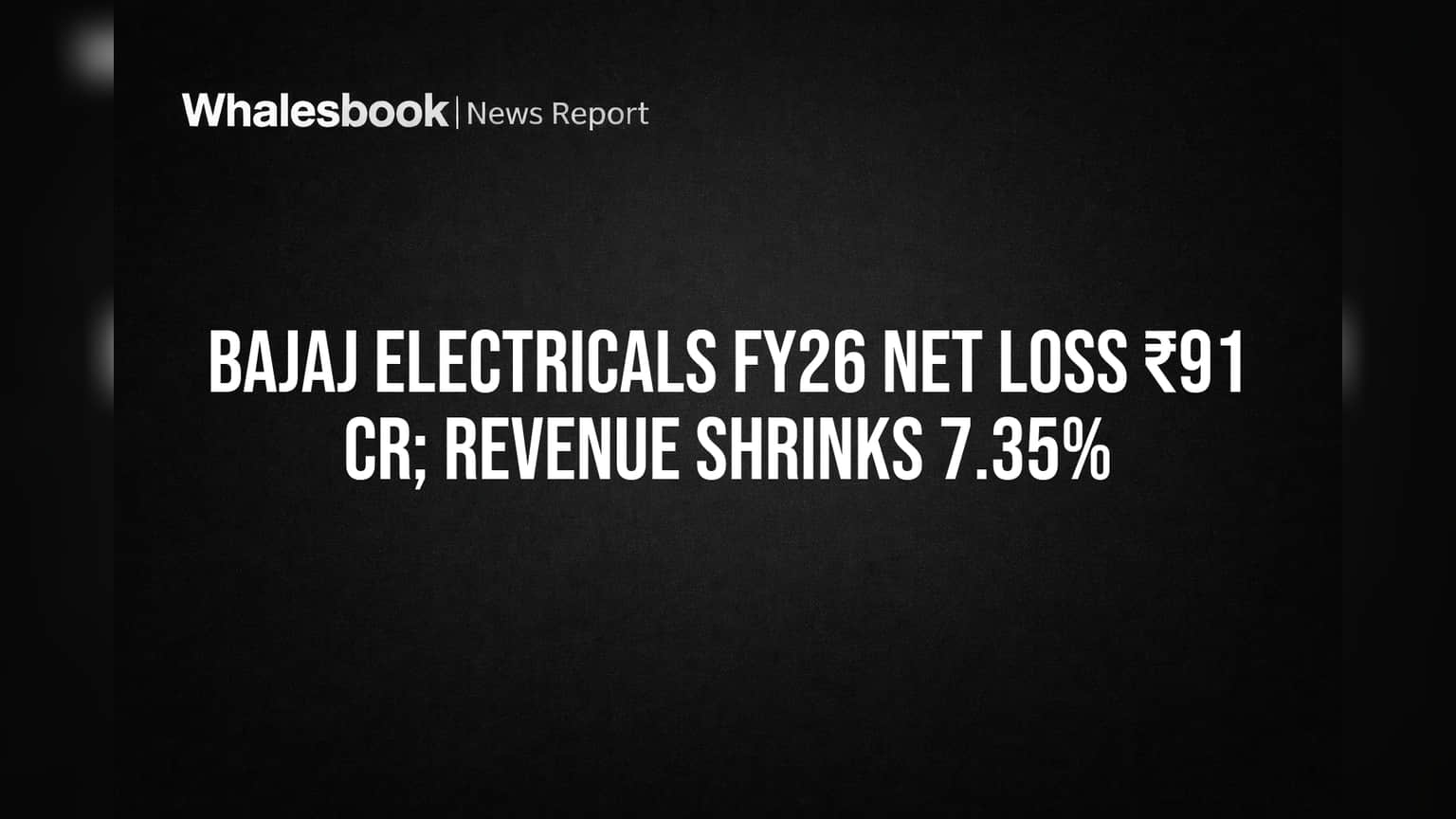


Bajaj Electricals Reports FY26 Net Loss Amid Revenue Drop
Full-Year Financial Performance
Bajaj Electricals announced its audited financial results for the fiscal year ending March 31, 2026. The consolidated annual net loss stood at ₹90.86 crore, a stark contrast to the ₹133.42 crore profit reported in the previous fiscal year (FY25).
The company's total income for FY26 saw a year-on-year decline of 7.35%, falling to ₹4,524.34 crore from ₹4,883.21 crore in FY25.
This revenue contraction was partly due to exceptional items totaling ₹91.15 crore, which included impairments of goodwill and property, plant, and equipment.
Standalone results also showed a net loss of ₹77.26 crore.
Key Challenges
The sharp swing from profit to loss, coupled with declining revenues, signals operational challenges for Bajaj Electricals. The significant impact of exceptional items, particularly asset write-downs, points to issues in asset management or valuation.
While the company maintained its dividend payout of ₹3.00 per share, suggesting confidence in future prospects or a commitment to shareholders, the underlying performance indicates a tough period.
Business Background
Bajaj Electricals has been operating in a challenging market, undertaking restructuring efforts and focusing on improving performance in its key segments. Historically, the company's Engineering, Procurement, and Construction (EPC) segment has been a source of volatility, contributing to significant losses in prior fiscal years, including FY23.
The company had previously announced strategic reviews of its EPC business to address these difficulties. In the consumer segment, it faces intense competition and fluctuating input costs.
What This Means for Shareholders
Shareholders will be concerned about the profitability decline and the decline in shareholder equity, which fell from ₹1,725.12 crore in FY25 to ₹1,594.18 crore in FY26.
The company faces pressure for a clear turnaround strategy for its loss-making operations.
Continued dividend payouts amidst losses might be unsustainable if profitability does not improve.
The future impact of asset impairments on depreciation and utilization needs monitoring.
Key Risks
- Revenue Contraction: The decline in revenue across segments threatens revenue growth.
- Profitability Pressure: Overcoming the consolidated net loss and achieving sustainable profitability will be crucial.
- Exceptional Charges: Further one-off charges could worsen financial performance.
- Balance Sheet Health: The decline in equity requires careful management for financial stability.
Peer Performance
Bajaj Electricals' peers like Havells India, Crompton Greaves Consumer Electricals, and V-Guard Industries have generally reported more stable or growing financial performances recently. These competitors often leverage strong brand equity, extensive distribution networks, and efficient operations to maintain profitability, setting a benchmark for Bajaj Electricals.
Financial Snapshot
The company maintained a dividend of ₹3.00 per share for FY26, unchanged from prior periods.
Exceptional items, including impairments of goodwill and property, plant, and equipment, totaled ₹91.15 crore in FY26.
Consolidated equity declined from ₹1,725.12 crore as of March 31, 2025, to ₹1,594.18 crore as of March 31, 2026.
Moving Forward
- Management commentary on the reasons for the FY26 losses and the specific nature of asset impairments.
- Outlook and recovery plans for both the consumer products and EPC segments.
- Any strategic decisions or divestments aimed at improving profitability and balance sheet health.
- Performance of competitors and broader industry trends in electricals and consumer durables.
- Future dividend policy in light of sustained losses.