 Whalesbook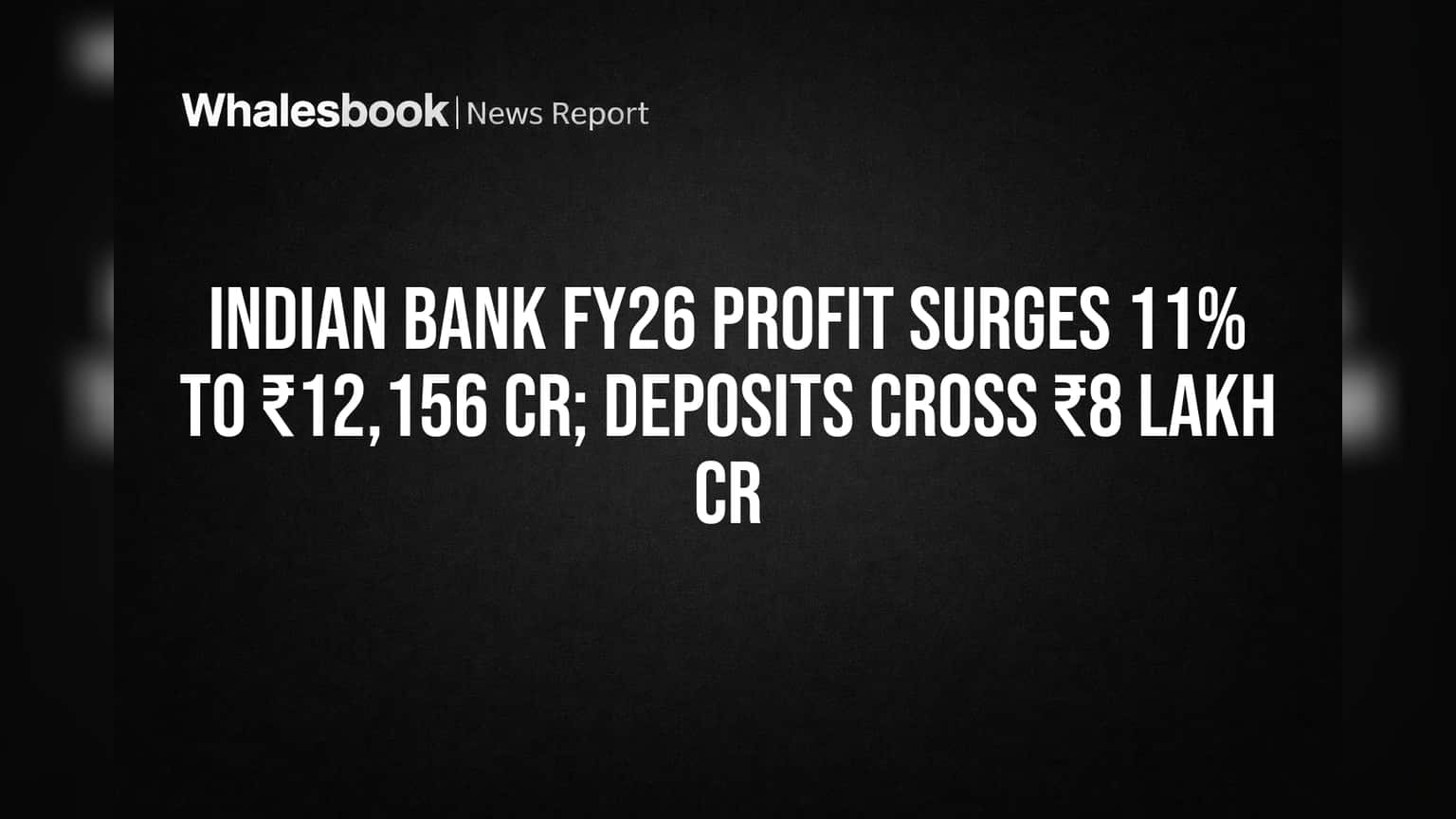


Indian Bank Reports Strong FY26 Results Driven by Business Growth
Financial Highlights
Indian Bank announced its full-year financial results for the fiscal year ended March 31, 2026. The bank reported a net profit of ₹12,156 crore, an 11% increase compared to ₹10,918 crore in FY25. Total deposits saw robust growth, rising 12.29% to ₹8,27,726 crore. Gross advances increased by a significant 13.6%, reaching ₹6,67,113 crore.
Key financial metrics remained stable, with Net Interest Margins (NIM) at 3.24% and Return on Assets (RoA) at 1.31%. The bank's asset quality was maintained, showing Gross Non-Performing Assets (NPA) at 1.98% and Net NPA at 0.15%.
Significance for Investors
This strong profit growth reflects healthy expansion and increased profitability for the bank. The robust expansion in both deposits and advances signals growing market share and active lending. Stable margins and asset quality suggest sound risk management and efficient operations. This financial strength supports investor confidence and the bank's capacity to contribute to economic growth.
Company Background
Indian Bank, a public sector entity with a legacy dating back to 1907, merged with Allahabad Bank in 2020. The bank had previously reported substantial profit growth in FY25, with net profit up 35.4% year-on-year. Its focus on retail, agriculture, and MSME segments has been a key driver for loan growth. In April 2025, Indian Bank was fined ₹1.61 crore by the Reserve Bank of India for regulatory compliance issues, including delays in fund transfers and specific lending norm deviations.
What Lies Ahead
Shareholders can expect the bank to continue focusing on profitability and business expansion. With a strong capital adequacy ratio (CRAR) of 17.93%, Indian Bank is well-positioned for future growth. The management's continued ability to sustain margins and manage asset quality will be key to future performance. The bank may also explore strategic initiatives or further market penetration using its financial strength. The previously announced plan to raise up to ₹5,000 crore in equity capital could be revisited based on market conditions and strategic requirements.
Key Risks to Monitor
Forward-looking statements in financial filings often involve risks and uncertainties that could cause actual results to differ from projections. Past regulatory actions, like the recent RBI penalty for compliance lapses, emphasize the need for strict adherence to evolving banking regulations. Broader economic factors, interest rate changes, and competition within the banking sector present ongoing challenges.
Competitive Landscape
Indian Bank operates alongside other major public sector banks such as State Bank of India (SBI) and Punjab & Sind Bank. SBI, as the largest public sector bank, sets a benchmark for asset size and operational scale. Private sector banks like HDFC Bank and ICICI Bank also represent significant competition in market share and innovation.
Key Financials
- Net Profit: ₹12,156 Cr (FY26) vs ₹10,918 Cr (FY25).
- Total Deposits: ₹8,27,726 Cr (FY26) vs ₹7,37,154 Cr (FY25).
- Gross Advances: ₹6,67,113 Cr (FY26) vs ₹5,88,140 Cr (FY25).
- Gross NPA: 1.98% (FY26) vs 3.09% (FY25).
- Net NPA: 0.15% (FY26) vs 0.19% (FY25).
- Net Interest Margin (NIM): 3.24% (FY26) vs ~3.37% (FY25).
- Return on Assets (RoA): 1.31% (FY26).
What to Watch Next
- Management commentary on future growth strategies and outlook.
- Progress on the ₹5,000 crore equity capital raising plan.
- The bank's ability to sustain double-digit advances growth and manage NIMs.
- Continued focus on asset quality and regulatory compliance.
- Performance of its retail, agriculture, and MSME (RAM) segments.
- Future dividend payouts and shareholder return ratios.